
TL;DR
Cat food home delivery in Australia is growing fast, but most options are region-locked. Pikko is the top pick for WA cat owners wanting gently cooked, human-grade meals with free delivery. CatChi covers NSW, VIC, and ACT with single-protein recipes. For eastern states raw feeding, Raw & Fresh delivers BARF meals. If you want shelf-stable premium food shipped anywhere in Australia, ZIWI Pets and Pet Circle are your best bets. International brands like Smalls (US) and KatKin (UK) don’t ship here.
Why Cat Food Home Delivery is Booming in Australia
Australian cat owners are leaving the supermarket aisle behind. The pet food market is expected to grow from $3.91 billion in 2025 to $5.24 billion by 2031, and the online channel is the fastest-growing segment at 6.4% CAGR. Fewer owners are buying pet food from supermarkets (dropping from 74% to 64% among dog owners, with cat owners following the same trajectory), while interest in natural, holistic, and functional nutrition keeps accelerating.
Premium raw and fresh pet food still accounts for only 1 to 3% of Australia’s pet food market, but industry forecasts project that share rising to 10%. Urban consumers, particularly in Perth, Sydney, Melbourne, and Brisbane, are driving adoption of direct-to-consumer models. Companies like Lyka (for dogs) proved the subscription model works here. Now the cat food delivery space is catching up.
The problem? Almost every “best cat food delivery” article online is written for the US or UK. Australian cat owners searching for home delivery options get results filled with brands that don’t ship here. This guide fixes that.
Take Pikko’s quiz to see which fresh recipes suit your cat, or read on for the full comparison.
At-a-Glance Comparison Table
| Service | Food Type | Daily Cost (approx.) | Delivery Area | Proteins Available | Portioning | Subscription Flexibility |
|---|---|---|---|---|---|---|
| Pikko | Gently cooked, frozen | Take quiz for pricing | WA (free delivery) | Chicken, Beef, Fish, Pork | ~200 kcal pre-portioned pouches | Pause, skip, no lock-in |
| CatChi | Gently cooked, frozen | ~$3–5/day (est.) | NSW, VIC, ACT | Chicken, Beef, Lamb, Pork | 100 kcal portions | Subscription, can adjust |
| Raw & Fresh | Raw (BARF), fresh | Varies by plan | NSW, VIC, QLD, ACT | Chicken, Beef, Kangaroo | Pre-portioned | Recurring orders |
| ZIWI Pets | Air-dried & canned | $4–7/day (est.) | Australia-wide | Multiple proteins | Self-serve from bag/can | Buy as needed |
| Pet Circle | Retailer (all types) | Varies by brand | Australia-wide (free over $49.99) | Hundreds of brands | Varies | Auto-ship available |
| Sosa Pet | Dry food subscription | Budget-friendly | Australia-wide | Limited range | Bags | Monthly subscription |
| Smalls | Gently cooked, frozen | US$3–5/day | US only | 5 recipes | Pre-portioned | Subscription (hard to cancel) |
| KatKin | Steam-cooked, frozen | ~£1.90/day | UK only | Multiple meats | Pre-portioned trays | Subscription |
What to Look for in a Cat Food Delivery Service
Before diving into individual services, it helps to understand what separates these products. One reviewer on a pet forum captured the confusion perfectly: they described spending “three evenings down a rabbit hole of subscription pages, ingredient labels, and Reddit threads” still unsure what they were buying, noting that “fresh, gently cooked, human-grade, and raw all start to sound the same.”
Here’s what actually matters.
Food Type: Gently Cooked vs Raw vs Air-Dried vs Kibble
Gently cooked means the food is cooked at lower temperatures than traditional pet food manufacturing, then frozen. This kills pathogens while preserving more nutrients than high-heat processing. It’s the middle ground between raw and kibble.
Raw (BARF) is uncooked meat, bones, and organs. Proponents argue it’s the most natural diet. The tradeoff is a real risk of bacterial contamination (Salmonella, E. coli) for both the cat and the humans handling it. For a deeper comparison, see this guide on fresh vs raw cat food safety.
Air-dried food is dehydrated at low temperatures. It’s shelf-stable and nutrient-dense, but low in moisture compared to fresh or canned options.
Dry kibble subscriptions deliver conventional cat food on a schedule. Convenient, cheap, but heavily processed.
AAFCO Compliance
AAFCO (Association of American Feed Control Officials) sets the nutritional standards that pet food should meet. A label reading “complete and balanced for all life stages” means the recipe provides everything a kitten, adult, or senior cat needs without supplementation. Every reputable fresh cat food delivery service should meet this baseline. If a brand can’t confirm AAFCO compliance, that’s a red flag.
Delivery Logistics
Frozen cat food needs to arrive frozen. This sounds obvious, but practitioners on Reddit and review sites report it’s a common failure point. Multiple Smalls customers in the US reported food arriving completely defrosted, with one saying “we took it to an Animal Shelter so it wouldn’t go to waste.” Another noted that “the danger zone is above 40 degrees. 50 degrees is still cold to the touch, but clearly not enough to prevent spoilage.”
For Australian conditions (especially WA summers), insulated packaging and reliable cold-chain logistics are non-negotiable. Ask any delivery service how they handle unattended doorstep drops.
Subscription Flexibility
This is where many services lose customers. Can you pause deliveries when you travel? Can you cancel online without calling a support line? Is there a minimum commitment?
The Smalls brand in the US is a cautionary tale. One ConsumerAffairs reviewer called it a “very deceptive subscription process” with “no way to cancel.” Another said: “My cat found the food to be inedible, and when I tried to cancel, they said the food had already been sent and could not be refunded. Now I’m stuck with $112 of food my cat won’t eat.” Before subscribing to any service, read Pikko’s guide on choosing a cat food subscription for questions you should ask first.
Portioning
Pre-portioned pouches or trays eliminate guesswork. You thaw one, serve it, done. Bulk packaging is cheaper but requires weighing and measuring, which most people won’t do consistently. For weight management in particular, accurate portioning matters more than most owners realize.
The 8 Best Cat Food Home Delivery Services
1. Pikko
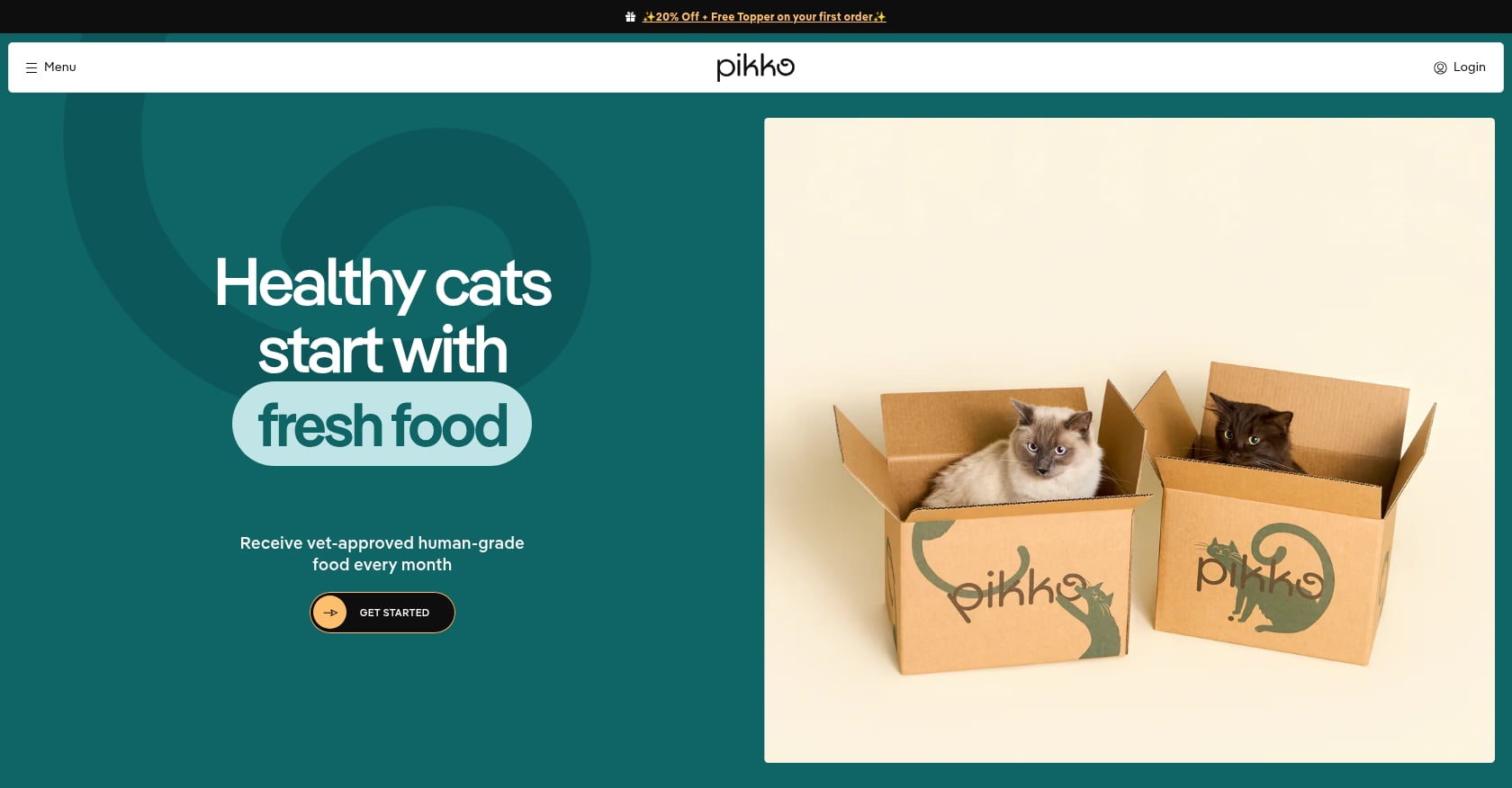
Best for: WA cat owners wanting gently cooked, human-grade meals with free home delivery
Pikko is an Australian fresh cat food subscription delivering human-grade, gently cooked meals made from 100% real meat. All recipes are nutritionist-formulated, AAFCO-balanced for all life stages, and vet approved.
Key features:
- Four recipes: chicken, beef, fish (chicken and sardine blend), and pork. Explore all four recipes.
- Each pouch contains approximately 200 kcal, designed as one full day’s food for an average 4.5 kg adult cat
- Gently cooked then snap-frozen, eliminating raw pathogen risks
- No grains, fillers, or preservatives
- High moisture content supports hydration and urinary health
- Free delivery across Western Australia in insulated boxes suitable for unattended doorstep drop-offs
- Flexible subscription with no lock-in, pause and skip options, and a trial box (14 pouches) for first-time customers
- Clear nutrition panels and ingredient lists on every recipe page
- WA-based, family-owned business using Australian-sourced ingredients
Tradeoffs:
- Currently ships within Western Australia only (Sydney expansion is in progress)
- Requires freezer space for 14 or 28 pouches
- The fish recipe is a chicken and sardine blend, not a single-protein option
- Pricing requires completing the quiz rather than being listed upfront
What customers say: Pikko holds an “Excellent” aggregate rating on Trustpilot across 41 reviews. Customers consistently report improved stools, fussy-eater acceptance, and fast delivery. Pet Food Reviews AU endorses the ingredient quality and macro profile. Several reviewers mention senior cats regaining appetite and energy within the first week.
2. CatChi
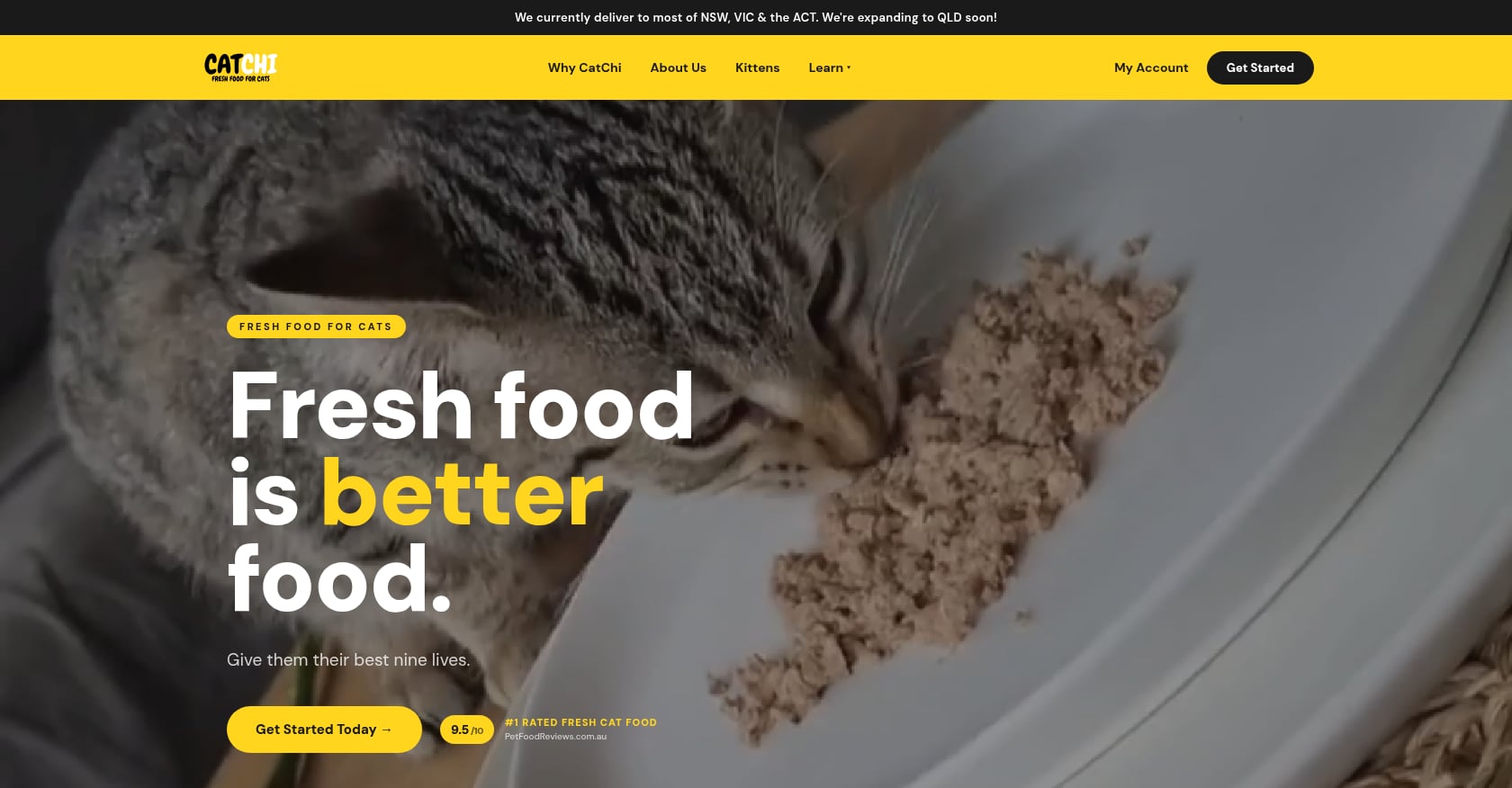
Best for: East-coast cat owners needing single-protein recipes for allergy management
CatChi is a Sydney-based fresh cat food delivery service offering gently cooked, frozen, human-grade meals with 95%+ meat content.
Key features:
- Four single-protein recipes: chicken, beef, lamb, and pork
- Each portion is 100 calories, making precise feeding easy for cats of different sizes
- Meets and exceeds AAFCO standards
- Ships frozen across NSW, VIC, and ACT (QLD coming soon)
- Vet-endorsed
- Scores 9.5 out of 10 on PetFoodReviews.com.au
Tradeoffs:
- Does not deliver to Western Australia or Queensland (yet)
- 100 kcal portions mean larger cats need multiple packs per day, which increases packaging waste
- No fish recipe for omega-3 variety
- Fewer recipe options than some competitors
What customers report: CatChi states that a large number of customers notice shinier, softer coats within a week of switching. They also note that about 30% of cats need some transition time to accept the new food, which is consistent with what other fresh food brands report.
3. Raw & Fresh
Best for: East-coast cat owners committed to raw BARF feeding
Raw & Fresh delivers raw cat food using chicken, beef, and kangaroo as protein sources. Unlike most competitors, they deliver fresh (not frozen), which means shorter shelf life but no thawing required.
Key features:
- Raw (BARF) formulation
- Human-grade ingredients
- Delivers fresh across Sydney, Melbourne, Brisbane, Canberra, and most regional areas in NSW, VIC, QLD, and ACT
- Pre-portioned for convenience
- Covers both cats and dogs
Tradeoffs:
- Raw food carries inherent pathogen risk (Salmonella, E. coli, Listeria) without the cooking step
- No delivery to Western Australia
- Primarily a dog-and-cat brand, not cat-specific in formulation focus
- Fresh delivery requires someone to be home or have reliable refrigeration immediately
- Shorter shelf life than frozen alternatives
What users say: Reviews are consistently positive, with customers praising timely delivery and the convenience of pre-portioned packs. However, the raw feeding approach remains controversial among veterinarians.
4. ZIWI Pets

Best for: Australian cat owners wanting premium nutrition without freezer commitment
ZIWI Pets, based in New Zealand, produces air-dried and canned cat food that ships across Australia. It’s not a fresh or frozen product, which is both its limitation and its advantage.
Key features:
- Air-dried recipes preserve nutrients without refrigeration
- Multiple protein options including venison, lamb, mackerel, and free-range chicken
- No grains, fillers, or artificial preservatives
- Available through retailers and online stores Australia-wide
- Long shelf life and no thawing required
Tradeoffs:
- Expensive per serve, often $4 to $7 per day depending on the recipe
- Not “fresh” in the way gently cooked or raw foods are
- Lower moisture content than frozen fresh food (cats prone to urinary issues may need additional water supplementation)
- Not a subscription delivery service, you buy through retailers
5. Pet Circle
Best for: Cat owners wanting convenient delivery of established commercial brands
Pet Circle is Australia’s largest online pet retailer, stocking hundreds of cat food brands across dry, wet, raw, and premium categories. It’s not a fresh food service but rather a delivery platform for existing brands.
Key features:
- Massive product range from budget to ultra-premium
- Free shipping on orders over $49.99, dispatched from centres in Melbourne, Perth, Sydney, and Brisbane
- Auto-ship subscription available for repeat purchases
- Loyalty program and regular sales
- Stocks brands like Royal Canin, Hill’s Science Diet, Applaws, and more
Tradeoffs:
- Not a fresh food service, no gently cooked or raw options made to order
- No personalisation based on your cat’s weight, age, or health needs
- You’re still choosing from commercially manufactured products
- Auto-ship is convenient but doesn’t replace a tailored nutrition plan
6. Sosa Pet
Best for: Budget-conscious Australian cat owners wanting a simple dry food subscription
Sosa Pet offers high-protein natural cat food on a subscription basis, delivered monthly anywhere in Australia. It’s a straightforward option for owners who want something better than supermarket kibble without jumping to fresh food.
Key features:
- High-protein dry food with natural ingredients
- Monthly subscription delivery Australia-wide
- Simple pricing and consistent supply
- Australian ingredients
Tradeoffs:
- Dry food only, no fresh, frozen, or wet options
- No personalisation beyond choosing a recipe
- Low moisture content compared to fresh alternatives
- Limited recipe range
7. Smalls
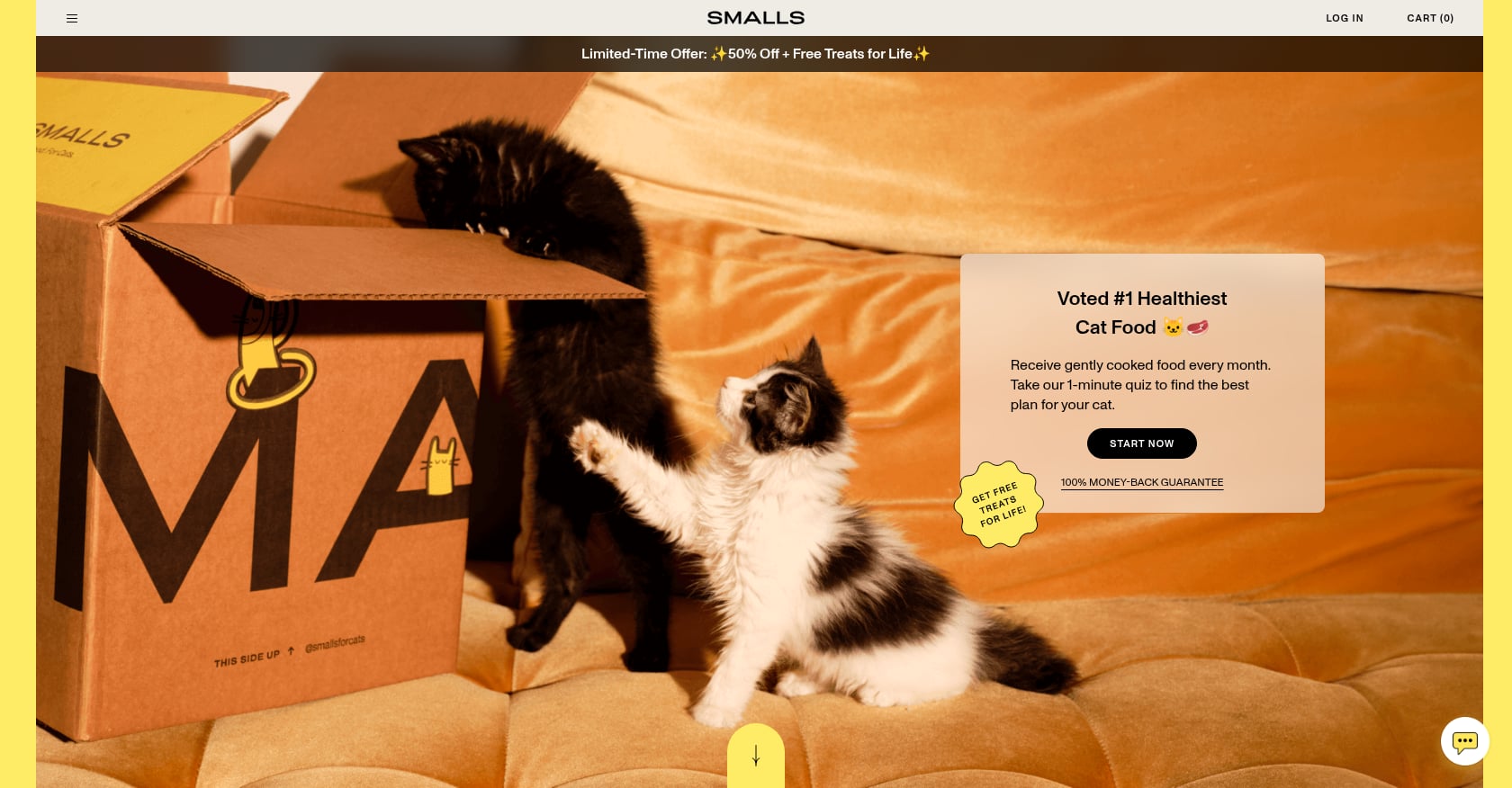
Best for: US cat owners wanting the widest recipe variety (does not ship to Australia)
Smalls is the most frequently recommended cat food home delivery service in US-focused articles. It’s included here as a benchmark because many Australian cat owners encounter it during research and wonder if it’s available locally. It is not.
Key features:
- Five gently cooked recipes: chicken, turkey, pork, fish, and a chicken-fish combo
- AAFCO approved for all life stages
- Pricing around US$3 to $5 per day, with trial offers starting at roughly US$1.25 per meal
- Also offers freeze-dried options alongside fresh
Tradeoffs:
- US only. Does not ship to Australia.
- Significant customer complaints about subscription cancellation. Trustpilot and ConsumerAffairs reviews describe difficulty pausing or cancelling, with auto-ship charges continuing after requests.
- Multiple reports of food arriving defrosted during transit
- Freezer space requirements are substantial
What users say: The food quality gets genuine praise. Trustpilot reviews highlight freshness and health improvements in cats. But the subscription management problems are serious. One reviewer described being stuck with $112 of food their cat wouldn’t eat after being unable to cancel in time. This is a pattern, not an isolated incident.
8. KatKin
Best for: UK cat owners wanting personalised, all-meat, portioned meal plans (does not ship to Australia)
KatKin is the UK’s leading fresh cat food delivery brand, offering 100% meat, gently steam-cooked, frozen meals. Like Smalls, it’s included for context since it appears frequently in global search results.
Key features:
- 100% meat recipes, gently steam-cooked
- Personalised portions based on your cat’s profile
- Estimated cost around £1.90 (roughly AU$3.60) per day
- Delivers across England, Wales, and most of mainland Scotland
Tradeoffs:
- UK only. No international shipping.
- Over 4,800 Trustpilot reviews with about 85% at five stars, but roughly 10% are one-star. Negative reviews frequently mention issues connected to new tray packaging.
- No Australian equivalent in terms of scale or brand recognition, yet
How to Transition Your Cat to Delivered Fresh Food
Cats are neophobic by nature. They distrust new things. This is why switching from kibble to fresh food isn’t always as simple as swapping out the bowl contents.
The gradual method works best for most cats. Start by placing a small spoonful of the new food in a separate dish next to their regular meal. Don’t mix it in. Let your cat investigate on its own terms. Over 7 to 14 days, increase the proportion of new food while reducing the old.
CatChi reports that about 30% of cats need extra time to accept fresh food. This is normal and doesn’t mean your cat won’t eventually love it. Patience matters more than strategy here. For the full step-by-step process, read this complete transition guide.
Some cats respond well to a “topper trick,” where you add a small amount of something irresistible on top of the new food. Pikko’s chicken breast meal topper works well for this, as does a sprinkle of nutritional yeast or a tiny amount of tuna water.
If your cat is an especially stubborn eater, the “cold turkey” method (removing old food entirely) sometimes works. But it requires monitoring to ensure your cat is actually eating enough. Cats should never go more than 24 hours without food, as this can trigger hepatic lipidosis, a serious liver condition.
Practical Tips for Making Cat Food Home Delivery Work
Freezer Space Planning
This is the number one practical barrier that people don’t think about until the box arrives. One UK pet forum user wrote: “with only having a tiny freezer space, they’re just not an option for me.”
Pikko’s trial box contains 14 pouches. A full subscription box holds 28 pouches. Each pouch is flat-packed, so they stack efficiently. A standard freezer drawer can comfortably hold 14 pouches. If you’re ordering 28, you’ll want a dedicated shelf or half a drawer cleared. Many customers find that finishing their current frozen food stockpile before the first delivery gives them the space they need.
The Thaw-and-Serve Routine
Move one pouch from the freezer to the fridge the night before. By morning, it’s thawed and ready to serve. Each Pikko pouch is approximately 200 kcal, which covers a full day for an average adult cat. Most owners split it across breakfast and dinner. For the exact method, check this guide on portioning a 200 kcal pouch across two meals.
Pausing Deliveries for Travel
Going on holiday? Boarding your cat? This is where subscription flexibility becomes critical. With Pikko, you can pause or reschedule deliveries without cancellation penalties. This is a genuine differentiator given the subscription complaints that plague other services in the US and UK.
Five Questions to Ask Before Subscribing to Any Cat Food Delivery
Based on common complaints across review sites and forums, these are worth checking before you commit:
- Can you cancel or pause online without calling support?
- Is there a minimum order commitment or lock-in period?
- What happens if food arrives thawed or damaged?
- How far in advance do you need to modify or skip an order?
- Is there a trial option so your cat can taste-test before you commit to a full subscription?
Frequently Asked Questions
Is fresh cat food delivery worth the extra cost?
It depends on what you’re comparing it to. Compared to supermarket kibble, fresh cat food costs more per day. But the ingredients are fundamentally different: whole meats versus rendered by-products, high moisture versus 10% moisture, minimal processing versus extrusion at extreme temperatures. Many owners report reduced vet bills related to urinary issues, digestive problems, and weight management. The higher upfront cost can offset downstream health expenses.
How long does frozen cat food last in the freezer?
Most brands recommend consuming frozen cat food within 3 to 6 months for optimal freshness, though it remains safe longer. Once thawed in the fridge, use it within 48 hours. Never refreeze thawed pouches.
Can kittens eat fresh delivered cat food?
Yes, provided the food is AAFCO-formulated for “all life stages.” This designation means the recipe meets the higher nutrient requirements of growing kittens as well as adult maintenance needs. Both Pikko and CatChi meet this standard. Kittens will typically need more calories per kilogram of body weight, so portions should be adjusted accordingly.
What if my cat refuses to eat the new food?
This happens with roughly 30% of cats, according to CatChi’s data. Start with gradual introduction rather than an immediate switch. Place a small amount of the new food in a separate bowl beside the regular food. Increase the ratio over 7 to 14 days. Adding a meal topper can help. If your cat hasn’t accepted the new food after two weeks of gradual introduction, it may simply not prefer that protein. Trying a different recipe before giving up entirely is worth the effort.
Is gently cooked cat food safer than raw?
Yes, from a pathogen perspective. Gentle cooking eliminates bacteria like Salmonella and E. coli that can be present in raw meat. This matters for the cat and for the humans in the household, especially children, elderly family members, or immunocompromised individuals. Read more about fresh vs raw safety.
Does cat food home delivery require a lot of freezer space?
It requires some planning, but less than most people expect. Flat-packed pouches stack efficiently. A 14-pouch trial box fits in a standard freezer drawer. Larger 28-pouch orders need roughly half a freezer shelf. The key is clearing space before your first delivery rather than scrambling when the box arrives.
What does “human-grade” actually mean for cat food?
Human-grade means every ingredient in the product is sourced, handled, and processed to standards legally suitable for human consumption. It’s a regulated term, not just marketing. For a full explanation of what human-grade means and why it matters, we’ve written a dedicated guide.
Can I get cat food delivered anywhere in Australia?
It depends on the service. Fresh cooked options are currently region-locked: Pikko delivers across WA, CatChi covers NSW, VIC, and ACT, and Raw & Fresh serves eastern metro and regional areas. Shelf-stable brands like ZIWI Pets and retailers like Pet Circle ship Australia-wide. The fresh cat food home delivery market is expanding, but nationwide coverage from a single brand isn’t available yet.
Ready to try fresh cat food home delivery for your cat? Pikko’s trial box of 14 pouches is the lowest-commitment way to find out if your cat prefers gently cooked, human-grade meals over what’s currently in the bowl.