
TL;DR
There is no formal “vet approved” certification for cat food in Australia. The term is largely unregulated marketing language. This guide breaks down what vet endorsement actually means, then ranks eight cat foods available in Australia across fresh, dry, wet, air-dried, and freeze-dried formats. Brands are evaluated on AAFCO compliance, genuine veterinary involvement in formulation, ingredient transparency, Australian availability, and honest pricing signals.
Quick Comparison Table
| Brand | Format | Price Tier | AAFCO Compliant | Vet Involvement | Best For | AU Availability |
|---|---|---|---|---|---|---|
| Pikko | Fresh gently cooked, frozen | $$$ | Yes (all life stages) | Nutritionist-formulated, vet-approved claims | Fresh meals, picky eaters, hydration | WA (free delivery) |
| Royal Canin | Dry, wet, prescription | $$–$$$ | Yes | Vet-formulated, in-house science team | Specific health conditions | National |
| Hill’s Science Diet | Dry, wet, prescription | $$–$$$$ | Yes | 220+ vets and food scientists on staff | Therapeutic/prescription needs | National |
| Advance | Dry, wet | $–$$ | Yes | Developed with vet nutritionists | Budget-conscious, Australian-made | National (supermarkets) |
| Purina Pro Plan | Dry, wet | $$ | Yes | WSAVA-aligned, clinical research | Everyday balanced nutrition | National |
| ZIWI Peak | Air-dried, canned | $$$$ | Yes | Formulated to nutritional standards | Premium raw-equivalent, shelf-stable | National |
| Feline Natural | Freeze-dried, canned | $$$$ | Yes | Formulated to nutritional standards | High meat content, premium canned | National |
| Black Hawk | Dry, wet | $$ | Yes | Australian formulation team | Mid-range natural, Australian-made | National |
Not sure which food suits your cat? Take Pikko’s quiz for a personalised recommendation.
What Does “Vet Approved” Actually Mean in Australia?
Here’s the uncomfortable truth: almost any cat food brand in Australia can print “recommended by veterinarians” on its packaging, and no regulatory body will stop them.
In Australia, pet food is essentially self-regulated. The Pet Food Industry Association of Australia (PFIAA) helped create the Australian Standard AS 5812, which replaced the older industry code of practice in 2011. But adherence to AS 5812 is voluntary. It is not a legal requirement to get pet food onto shelves, and nobody checks compliance. The PFIAA was one of the key players involved in writing the standard, so the industry effectively wrote its own rules.
This matters because when you see “vet approved cat food” on a product sold in Australia, you should ask: approved by whom, and under what framework?
The Vet Endorsement Hierarchy
These terms sound similar but mean very different things:
-
Formulated by a Board-Certified Veterinary Nutritionist. This is the gold standard. A specialist with postgraduate credentials in animal nutrition designed the recipe, accounting for how each ingredient contributes to the overall nutrient profile.
-
Veterinarian formulated. A vet played a role in designing the diet. This is meaningful but less specific, because a general practice vet may not hold specialist nutrition qualifications.
-
Veterinarian recommended. A significant number of vets recommend the product. This usually comes from feeding trials, clinical outcomes, or brand reputation, but the threshold for “significant” is vague.
-
AAFCO/FEDIAF compliant. The food meets established nutritional adequacy standards for cats. Australia does not have its own feeding trial facilities, so the industry generally follows AAFCO requirements, though compliance is self-declared.
-
WSAVA-aligned. The brand meets criteria set by the World Small Animal Veterinary Association around employing qualified nutritionists, conducting quality control, and publishing research. But WSAVA does not approve or reject specific cat foods. It provides a framework of questions to help vets and owners evaluate brands.
-
Marketing “vet approved.” Potentially meaningless without specifics. Under AAFCO’s own model regulations in the US, the phrase “veterinarian approved” is actually not permitted because it implies a formal endorsement that doesn’t exist. Australian rules are even looser.
The WSAVA Conflict Worth Knowing About
Only four cat food brands consistently meet AAFCO, FDA, and WSAVA standards: Purina, Hill’s Pet Nutrition, Royal Canin, and Iams. But there’s a wrinkle. WSAVA’s Global Nutrition Committee is financially supported by the Purina Institute, Hill’s Pet Nutrition, and Royal Canin. That doesn’t automatically invalidate the guidelines, but it’s worth factoring in when someone tells you only WSAVA-aligned brands are trustworthy. Smaller brands that employ qualified nutritionists and meet AAFCO standards can produce excellent food without appearing on the WSAVA shortlist.
For a deeper look at how vet recommendations work in Australia, read our vet-recommended cat food guide.
How We Evaluated These Cat Foods
Every brand on this list was assessed against the same criteria:
- AAFCO compliance: Does the product carry a nutritional adequacy statement?
- Vet involvement: Who formulated it, and what are their qualifications?
- Ingredient transparency: Are protein sources named? Are nutrition panels published?
- Format and moisture content: Relevant for hydration and urinary health.
- Australian availability and pricing: Can you actually buy it, and at what cost?
- Real user feedback: What do Australian cat owners actually report?
Pikko publishes this article. The evaluation criteria apply equally to every brand listed.
The 8 Best Vet Approved Cat Foods in Australia
1. Pikko Fresh Cat Food
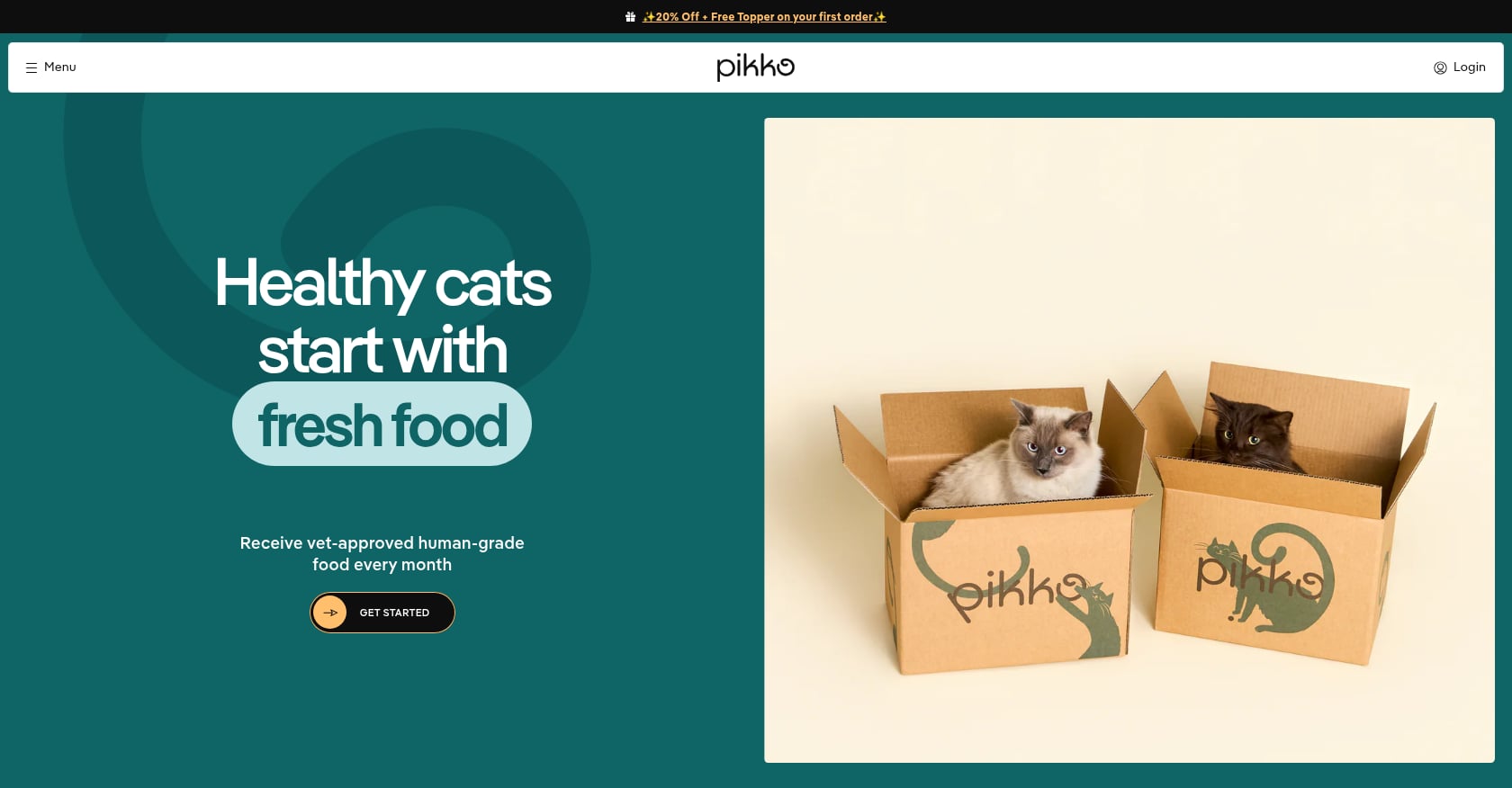
Best for: Health-conscious cat owners wanting fresh, portion-controlled meals with high moisture
Pikko is an Australian fresh cat food subscription delivering gently cooked, human-grade meals made from 100% real meat. Each frozen pouch contains approximately 200 calories, designed as one full day’s food for an average adult cat (~4.5 kg). The meals are AAFCO-formulated for all life stages (kittens, adults, and seniors) and are nutritionist-formulated.
Key features:
- Four recipes: chicken, beef, fish, and pork
- 100% human-grade meats, no grains, fillers, or preservatives
- High moisture content (~70%), supporting urinary and digestive health
- Gently cooked (not raw), reducing pathogen risk while preserving nutrients
- Transparent ingredient lists and nutritional panels for every recipe
- Flexible subscription with a discounted trial box of 14 pouches
Pricing: Trial box (14 pouches) at a discounted first-order rate. Full subscription box is 28 pouches with flexible scheduling. Exact pricing is available through the quiz and checkout.
Availability: Currently delivering across Western Australia with free delivery. Sydney and national expansion is underway.
Tradeoffs:
- WA-only delivery as of mid-2026, limiting access for eastern states
- Requires freezer space and thaw planning
- Fish recipe is a chicken and sardine blend, not single-protein
- Cost sits above supermarket brands
- Minimal dental benefit compared to raw bones or dental kibble
Real user perspective: On Trustpilot, Pikko holds an “Excellent” aggregate across 41 reviews. Customers highlight improved stool quality, fussy-eater acceptance, and fast delivery. Multiple reviewers mention older cats regaining appetite and energy after switching.
Interested in seeing exactly what goes into each recipe? Explore Pikko’s recipes.
2. Royal Canin
Best for: Cats with specific breed, age, or health requirements needing clinically validated nutrition
Royal Canin is a staple in Australian vet clinics. Its formulations cover an unusually wide range of needs: breed-specific diets, kitten-to-senior life stages, and prescription lines for urinary, renal, gastrointestinal, and weight conditions. It’s one of the four brands that consistently meets WSAVA criteria.
Key features:
- Extensive range across dry kibble, wet pouches/cans, and veterinary prescription diets
- In-house team of veterinarians, food scientists, and nutritionists
- Fixed recipes where exact ingredients remain identical batch to batch for digestive stability
- Widely stocked at Pet Circle, PetBarn, and vet clinics nationally
Pricing: $$ to $$$. Dry food typically runs $12 to $22/kg depending on bag size and retailer. Prescription diets cost more.
Availability: National, both online and in-store.
Tradeoffs:
- Some recipes use composite protein sources and grains, which ingredient-focused owners may find unappealing
- Prescription lines require a vet consultation
- Ingredient lists won’t impress anyone looking for whole-food simplicity
Real user perspective: Practitioners on Reddit and Australian pet forums frequently note Royal Canin as the default vet recommendation, particularly for cats with diagnosed conditions. The consistency across batches is something owners of cats with sensitive stomachs value highly.
3. Hill’s Science Diet
Best for: Cats needing targeted therapeutic diets prescribed by a veterinarian
Hill’s operates two main lines: Science Diet for everyday wellness and Prescription Diet for clinical conditions. The company employs over 220 veterinarians, food scientists, and nutritionists, and its prescription range is one of the most extensively researched therapeutic cat food lines available in Australia.
Key features:
- Science Diet covers general wellness for kittens, adults, indoor cats, and seniors
- Prescription Diet targets urinary, kidney, weight, and gastrointestinal conditions
- Backed by clinical research and feeding trials
- WSAVA-aligned with full-time board-certified veterinary nutritionists
Pricing: $$ to $$$$. Comparable to Royal Canin for everyday lines. Prescription diets carry a significant premium.
Availability: National through vet clinics, PetBarn, Pet Circle, and online retailers.
Tradeoffs:
- Some formulas contain artificial flavours
- Prescription diets require vet authorisation and ongoing vet relationship
- High cost relative to non-therapeutic alternatives
- Ingredient lists feature by-products and grains that some owners want to avoid
Real user perspective: One Australian cat owner shared in a product review that their cat was transitioned to Hill’s c/d Multicare Stress wet and dry food on vet advice, and eight months later, the cat’s urinary issues had fully resolved. Stories like this illustrate why vets reach for Hill’s in clinical situations.
4. Advance
Best for: Budget-conscious Australian owners who want local, vet-endorsed nutrition
Advance is made in Australia and developed in collaboration with veterinary nutritionists. It covers kitten through senior formulas and delivers solid nutritional value at a price point well below the premium brands. For many Australian households, Advance represents the sweet spot between supermarket cat food and clinical-grade options.
Key features:
- Australian-made with formulations tailored to local conditions
- Covers all life stages: kitten, adult, and senior
- Available at supermarkets, pet stores, and online
- Developed with veterinary nutritionist input
Pricing: $ to $$. One of the most affordable vet-endorsed options.
Availability: National. Widely stocked in Coles, Woolworths, PetBarn, and online.
Tradeoffs:
- Ingredient lists include more grains and fillers than premium brands
- Fewer specialised therapeutic or prescription lines
- Not as extensively researched as Hill’s or Royal Canin
- Limited wet food range compared to competitors
Real user perspective: Australian cat owners on forums frequently recommend Advance as the go-to when budget matters. One common sentiment: it’s the best option you can pick up during a regular grocery run without compromising on basic nutritional adequacy.
5. Purina Pro Plan
Best for: Everyday balanced nutrition backed by extensive clinical research
Purina Pro Plan sits in the moderate-price tier but punches above its weight in terms of research backing. It follows WSAVA’s Global Nutrition Guidelines and AAFCO standards, with formulas covering kittens, adults, seniors, and specific health concerns like urinary and digestive support.
Key features:
- WSAVA-aligned and AAFCO compliant
- Formulas for urinary health, digestive care, weight management, and kitten growth
- Backed by Purina’s Nestlé research infrastructure
- Widely available in Australian pet retailers
Pricing: $$. Mid-range and accessible.
Availability: National across PetBarn, Pet Circle, and some supermarkets.
Tradeoffs:
- Some products contain artificial flavors and guar gum, which may affect stool quality in cats with sensitive stomachs
- Part of the Nestlé portfolio, which some consumers prefer to avoid on principle
- Ingredient lists feature by-products and processed proteins
Real user perspective: Practitioners on pet nutrition forums note Purina Pro Plan as a solid “unglamorous” choice. It doesn’t generate excitement on ingredient lists, but vet nutritionists consistently point to its research base as a differentiator from boutique brands that lack feeding trial data.
6. ZIWI Peak
Best for: Owners wanting raw-equivalent nutrition in a shelf-stable, convenient format
ZIWI Peak is a New Zealand brand offering air-dried and canned cat food with exceptionally high meat content. An astounding 96% of the air-dried chicken recipe comes from chicken, organs, and bones, plus New Zealand green-lipped mussels for joint support.
Key features:
- 96% meat, organs, and bone in air-dried recipes
- Includes New Zealand green-lipped mussels (natural source of glucosamine)
- No grains, potatoes, or fillers
- Shelf-stable air-dried format eliminates freezer requirements
- Canned options also available
Pricing: $$$$. Air-dried bags run around $35 for 400g and $70 for 1kg. A tray of twelve 185g cans costs approximately $60 to $70.
Availability: National through pet retailers and online stores.
Tradeoffs:
- Very expensive, and recent price increases have frustrated Australian buyers
- NZ-made, not Australian
- Recently acquired by Chinese investors, generating quality-concern discussions in pet communities
- Some cats reject the air-dried texture
- The shelf-stable format, while convenient, lacks the moisture content of wet or fresh foods
Real user perspective: One Australian cat owner on a pet food forum noted: “The recent price hike here in Australia is crazy. Almost a 30% price increase. I want to always give my two cats the best but it’s getting hard.” If budget isn’t a constraint, ZIWI Peak is excellent. For anyone curious about how fresh food compares to air-dried or raw alternatives, our fresh vs raw comparison breaks down the differences.
7. Feline Natural
Best for: Premium canned feeding with the highest meat content in the category
Feline Natural (also known as Feline Naturals) is another New Zealand brand that competes at the top end of the market. It offers freeze-dried and canned cat food with meat content that, according to independent reviewers, exceeds even ZIWI Peak’s canned range.
Key features:
- Extremely high meat content in canned recipes
- NZ-sourced, ethically raised ingredients
- Freeze-dried options available for convenience
- No grains, fillers, or artificial preservatives
Pricing: $$$$. Premium pricing in line with or slightly above ZIWI Peak.
Availability: National through specialty pet retailers and online.
Tradeoffs:
- Very expensive for everyday feeding
- NZ-imported, not Australian-made
- Limited flavour range compared to larger brands
- Freeze-dried format requires rehydration
- Less clinical research backing than WSAVA-aligned brands
Real user perspective: One reviewer on Pet Food Reviews Australia stated: “I feed nothing but Feline Naturals to my kitties. I personally feel it’s the healthiest one not only in Australia, but the world.” That’s a strong endorsement, though the price makes it impractical for many households.
8. Black Hawk
Best for: Australian-made natural nutrition at a mid-range price
Black Hawk is an Australian brand that occupies the space between supermarket options and ultra-premium imports. Its recipes commonly start with named meats or meat meals and named oils (such as emu oil), with fewer artificial colours and flavours than budget competitors. Both grain-inclusive and grain-free options are available.
Key features:
- Australian-made with named protein sources
- Includes functional ingredients like emu oil
- Grain-inclusive and grain-free lines available
- Mid-range pricing makes it accessible for most budgets
Pricing: $$. Competitive against Advance while offering a more “natural” ingredient profile.
Availability: National through pet stores and online retailers.
Tradeoffs:
- Not as clinically validated as Royal Canin or Hill’s
- No prescription or therapeutic diet lines
- Some formulas still contain fillers and generic ingredients lower on the panel
- Less independent research and feeding trial data than WSAVA-aligned brands
Real user perspective: Australian pet owners on discussion boards often position Black Hawk as the “step up” from supermarket food that doesn’t require a premium budget. It’s a popular recommendation for owners transitioning away from grocery-store brands for the first time.
What to Look for on an Australian Cat Food Label
Given how weak Australian pet food regulation is, informed consumers need to self-navigate. Here’s what to check before buying any cat food marketed as vet approved in Australia.
The AAFCO nutritional adequacy statement. This is the single most important thing on the label. It tells you the food has been formulated (or tested through feeding trials) to meet complete and balanced nutrition standards for a specific life stage. Some products still appear on Australian shelves without this statement, so always look for it.
Named protein sources. “Chicken” or “beef” is better than “meat” or “animal derivatives.” Under the Australian Standard, manufacturers can name a food after an animal protein that makes up just 5% of the product. A “chicken dinner” might be 95% something else.
Life-stage designation. “All life stages” means the food meets the higher nutritional demands of kittens (and therefore covers adults too). “Adult maintenance” is formulated only for adult cats.
Moisture content. This matters more than most owners realise. Dry kibble sits around 10% moisture. Wet food is 75 to 80%. Fresh gently cooked food typically hits around 70%. Cats evolved as desert animals that derive most of their water from prey, so higher moisture foods support kidney and urinary tract health.
As WSAVA itself notes, the ingredient list alone gives no information about ingredient quality and can be very misleading about overall quality. For more on what “human-grade” really means on an Australian label, read our human-grade cat food guide.
Wet vs Dry vs Fresh: Which Format Is Best?
Most Australian veterinarians recommend a combination of both dry and wet cat food. But the landscape is shifting as fresh gently cooked options enter the market.
Dry kibble is convenient, shelf-stable, and affordable. It can benefit dental health through mild abrasion. The major downside is moisture content of only about 10%, which forces cats to drink more water to compensate, and most cats are poor voluntary drinkers.
Wet canned/pouched food provides 75 to 80% moisture, closer to what cats naturally consume. It’s more palatable for picky eaters and better for urinary health. The tradeoff is shorter shelf life once opened and higher cost per calorie.
Fresh gently cooked food occupies the emerging middle ground. It offers high moisture (around 70%), named whole-food ingredients, and gentler processing that preserves more bioavailable nutrients than high-heat extrusion used in kibble. Organisations like the AVMA and AAHA discourage raw feeding due to bacterial contamination risk, so gently cooked addresses pathogen concerns while staying closer to a minimally processed diet.
Air-dried and freeze-dried formats (like ZIWI Peak and Feline Natural) provide very high meat content in a shelf-stable form, but they’re low in moisture and expensive.
A standard 4 kg adult cat generally requires approximately 250 calories per day. Whichever format you choose, matching calorie intake to your cat’s weight and activity level matters more than format alone. For help with portioning, see our guide on portioning daily pouches.
How to Transition Your Cat Safely
Switching cat food abruptly is a common mistake. Always transition over 7 to 10 days to avoid digestive upset. Mix an increasing amount of the new food with the current diet:
- Days 1 to 3: 25% new food, 75% current food
- Days 4 to 6: 50/50 mix
- Days 7 to 9: 75% new food, 25% current food
- Day 10: 100% new food
Some cats, particularly fussy eaters, may need longer. Others transition faster without any issues. If your cat resists the switch, our complete transition guide covers strategies for both gradual and cold-turkey approaches, plus tips specifically for picky cats.
The Bottom Line
True vet approval in Australia means more than a label claim. It means AAFCO compliance, qualified nutritionist involvement in formulation, transparent ingredients, and ideally, real feeding outcomes that owners can verify.
The eight brands listed here represent the strongest options across every format and budget. Whether you choose a WSAVA-aligned clinical brand like Royal Canin, an affordable Australian-made option like Advance, or a fresh gently cooked approach, the critical step is the same: look past marketing language and check what’s actually in the food and who formulated it.
A cat can be “fed” but still receive a nutritionally unbalanced or poorly tested diet, and over time, that can lead to preventable disease. Choosing well today saves vet bills (and heartache) tomorrow.
Ready to try fresh, gently cooked cat food? Start with Pikko’s trial box, a 14-pouch introductory order with free delivery across Western Australia.
Frequently Asked Questions
Is there an official “vet approved” certification for cat food in Australia?
No. Australia has no formal vet-approval certification for pet food. The Australian Standard AS 5812 is voluntary, and adherence is not enforced. Any brand can use terms like “vet recommended” or “vet approved” without regulatory oversight. The closest thing to a meaningful standard is AAFCO nutritional adequacy compliance, combined with evidence that a qualified nutritionist or veterinarian formulated the diet.
What does WSAVA-approved mean for cat food?
WSAVA does not approve or reject specific cat foods. Instead, the World Small Animal Veterinary Association provides a set of guideline questions to help vets and pet owners evaluate whether a brand meets certain quality, research, and nutrition standards. The four brands most commonly cited as meeting WSAVA criteria are Purina, Hill’s, Royal Canin, and Iams, though it’s worth noting that three of those brands fund WSAVA’s nutrition committee.
Is grain-free cat food better?
Not necessarily. Grain-free does not mean low-carb. Many grain-free formulas replace grains with potatoes, peas, or legumes, which can carry similar or even higher carbohydrate loads. Unless your cat has a diagnosed grain intolerance (which is uncommon), grain-inclusive formulas can be perfectly healthy and are often more affordable.
Why do Australian vets recommend Royal Canin and Hill’s so often?
These brands employ large teams of veterinary nutritionists, conduct feeding trials, and produce prescription diets for specific medical conditions. Vets recommend them because the clinical evidence base is extensive and the formulations are consistent batch to batch. That said, they aren’t the only quality options available, and newer categories like fresh gently cooked food also meet AAFCO standards with arguably better ingredient transparency.
How much should I feed my cat per day?
A standard 4 kg adult cat generally requires approximately 250 calories per day, though this varies with age, activity level, and health status. Always check the calorie content on the packaging and adjust based on your cat’s body condition. Overweight cats may need less, while active or growing kittens need more.
Is fresh cat food safer than raw?
Yes, from a pathogen standpoint. Organisations like the AVMA and AAHA discourage raw feeding due to bacterial contamination risk (Salmonella, Listeria, E. coli). Gently cooked fresh food eliminates these risks through controlled heat processing while preserving more nutrients than the high-temperature extrusion used to make kibble.
Can I mix wet and dry cat food?
Yes, and most Australian vets recommend exactly this. Combining formats gives your cat the dental benefits and convenience of kibble alongside the hydration and palatability of wet food. The key is to account for total daily calories across both formats so you don’t overfeed.
How do I know if a cat food meets AAFCO standards in Australia?
Look for a nutritional adequacy statement on the packaging. It will say something like “formulated to meet the nutritional levels established by the AAFCO Cat Food Nutrient Profiles for [life stage].” If this statement is missing, the product may not be complete and balanced, regardless of what the front of the bag claims.